Quick answer
For a Chicago garage, the best system usually uses both: an epoxy base coat for strong bonding and build, and a polyaspartic topcoat for UV stability, road-salt resistance, scratch resistance and fast return to service. All-epoxy is cheaper but cures slower and can yellow in sunlight.
“Epoxy” has become the catch-all name for garage floor coatings, but if you’re getting quotes in Chicagoland you’ll also hear polyaspartic and polyurea. Which one is better for a garage that sees snow, slush and road salt five months a year?
The short answer: they’re best together. Here’s why.
The quick comparison
| Epoxy | Polyaspartic | |
|---|---|---|
| Bond to concrete | Excellent | Very good (with proper prep) |
| Build / thickness | High — fills and levels well | Thinner per coat |
| Cure time | Slow (often days before parking) | Fast (often 24–48 hrs to park) |
| Cold-weather install | Needs warmer slab temps | Cures at much lower temps |
| UV stability | Can yellow/amber in sunlight | UV stable, stays clear |
| Flexibility | Rigid | More flexible |
| Road salt & chemical resistance | Good | Excellent |
| Scratch / abrasion resistance | Good | Excellent |
| Cost | Lower | Higher |
Where epoxy shines
Epoxy is a two-part resin that penetrates and bonds tenaciously to properly ground concrete. It builds thickness quickly, which helps it level minor surface imperfections and hold decorative flake. For the base coat of a garage system, epoxy is hard to beat on performance per dollar.
Its weaknesses are on the surface: standard epoxy can yellow under UV light and is more prone to fine scratching. It also cures slowly, especially when the slab is cold — which matters in an Illinois garage in October or March.
Where polyaspartic shines
Polyaspartic is a type of polyurea designed for coatings. It cures fast, stays clear and glossy in sunlight, and is more flexible — useful when concrete expands and contracts through freeze-thaw cycles. It also stands up very well to the brine and rock salt that drip off cars all winter.
The trade-offs: material costs more, the fast cure gives installers less working time (this is not a beginner product), and it needs a mechanically ground surface to bond well.
Why many Chicagoland garages use both
The most common high-performance garage system pairs the strengths of each:
- Diamond-ground concrete with cracks and salt damage repaired.
- Epoxy base coat for bond and build.
- Full broadcast of decorative flake.
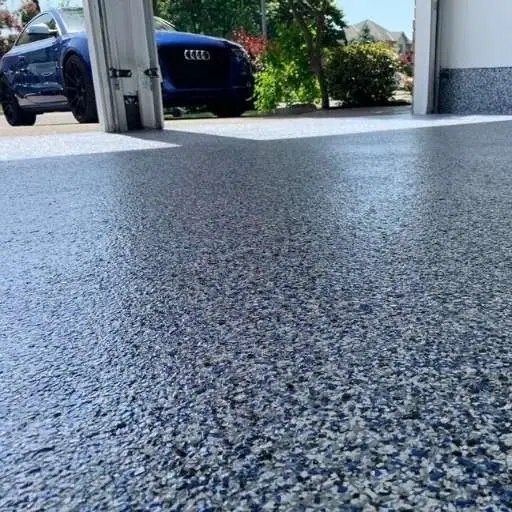
- Polyaspartic clear topcoat for UV stability, salt resistance and scratch resistance.
You get epoxy’s grip on the slab and polyaspartic’s toughness where the tires meet the floor.
What about installing in winter?
Because polyaspartic cures at lower temperatures, it makes off-season installs more realistic in an unheated garage. What really matters is the slab temperature, the air temperature relative to the dew point, and how much moisture is in the concrete — not just the forecast. A good installer measures all three before opening a can.
Which should you choose?
- Daily-driver garage, parked cars, winter slush: epoxy base + polyaspartic topcoat.
- Lightly used space, tighter budget, no sun exposure: an all-epoxy system can work well.
- Workshop with chemicals or heavy rolling loads: ask about thicker, industrial-grade epoxy builds — see our commercial and industrial systems.
Still deciding? Our garage floor cost guide shows how each choice affects price, and how road salt damages garage floors explains why the topcoat matters so much here.
DuraCore Industrial installs epoxy and hybrid coating systems for homes across Chicagoland. We’ll test your slab and recommend the system that fits how you use your garage.
Frequently Asked Questions
Is polyaspartic better than epoxy for a garage floor?
For the top layer of a garage floor in a cold, salty climate like Chicago, polyaspartic usually performs better: it is UV stable, more flexible and more resistant to road salt and scratches. Epoxy is still an excellent, cost-effective base coat. Many of the best systems use an epoxy base with a polyaspartic topcoat.
Can polyaspartic be installed in cold weather?
Yes. Polyaspartic coatings cure at much lower temperatures than standard epoxy, which makes late-fall and winter installs in unheated garages more practical. Slab temperature and dew point still need to be checked before coating.
Does epoxy turn yellow?
Standard epoxy can amber or yellow with UV exposure, which is noticeable near an open garage door. A UV-stable polyaspartic or polyurethane topcoat prevents that.
How soon can I park on a polyaspartic floor?
Polyaspartic topcoats often allow foot traffic within hours and vehicle traffic in about 24–48 hours, versus several days for an all-epoxy system. Your installer will give exact times for the products used.